
Rotomairewhenua, commonly known as Blue Lake, is widely recognised by scientists as having some of the clearest natural freshwater ever measured. Located in Nelson Lakes National Park in New Zealand’s South Island, the lake has recorded water clarity of around 70–80 metres, a level comparable to distilled water under laboratory conditions. This recognition is based on repeated scientific measurement and long-term research, not on an annual award or promotional title.
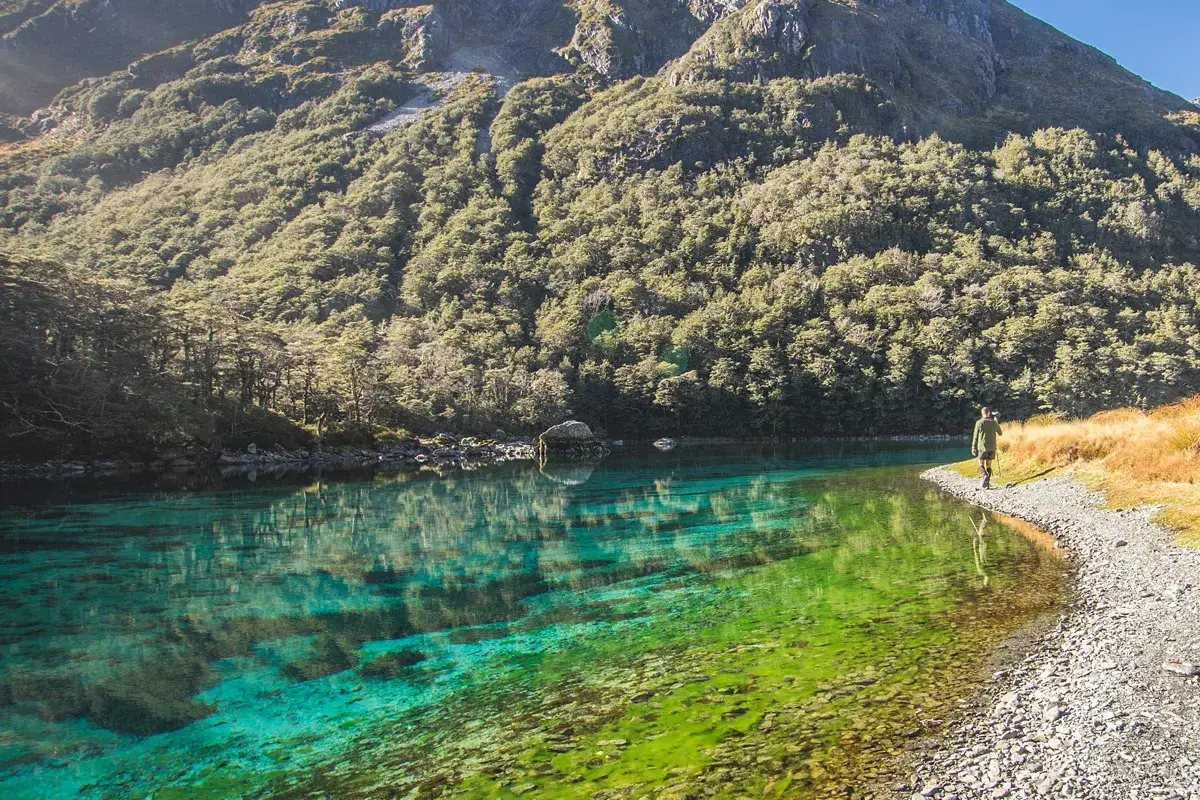
Rotomairewhenua sits within Nelson Lakes National Park, in a remote alpine catchment shaped by glacial and geological processes
The lake’s clarity is not accidental; it is the result of a highly specific natural system that filters water before it ever reaches the lake itself.
Scientific research referenced by NIWA (Earth Sciences New Zealand) shows that water feeding Rotomairewhenua originates from nearby Lake Constance and travels underground through ancient landslide debris and glacial gravels. This natural filtration removes almost all suspended particles and organic matter, producing water of exceptional optical purity.
Measured visibility of 70–80 metres places Rotomairewhenua at the upper limit of what is possible in natural freshwater systems.
For comparison, Te Waikoropupū Springs in Golden Bay – long regarded as one of the clearest freshwater sites in the world – measures around 63 metres of visibility, Blue Spring (Te Waihou Walkway, Putaruru, New Zealand) has a visual clarity of up to 50 meters.
Rather than being a one-off scientific finding, Rotomairewhenua’s status is supported by consistent validation over time
In recent years, including ongoing discussions in 2025, attention has increasingly focused on protecting this clarity. Of particular concern is lake snow – microscopic planktonic colonies that can be transferred on footwear and equipment and pose a serious risk to ultra-clear freshwater environments.
Rotomairewhenua holds deep cultural significance. The lake is considered tapu (sacred) by Ngāti Apa ki te Rā Tō, and its protection reflects long-held values of guardianship, respect for water, and environmental responsibility.
While there is no formal “world’s clearest lake” award issued in any given year
Rotomairewhenua continues to hold a rare scientific distinction. Based on NIWA-referenced research and repeated measurement, it remains among the clearest natural freshwater bodies ever measured, and one of New Zealand’s most scientifically significant lakes.
Citation:
Earth Sciences New Zealand | NIWA — Blue Lake: New Zealand treasure